 ComingUp
MenuPlan AI
Android meal planner with AI recipe tools and shared groceries in 6 languages

Gallery
About
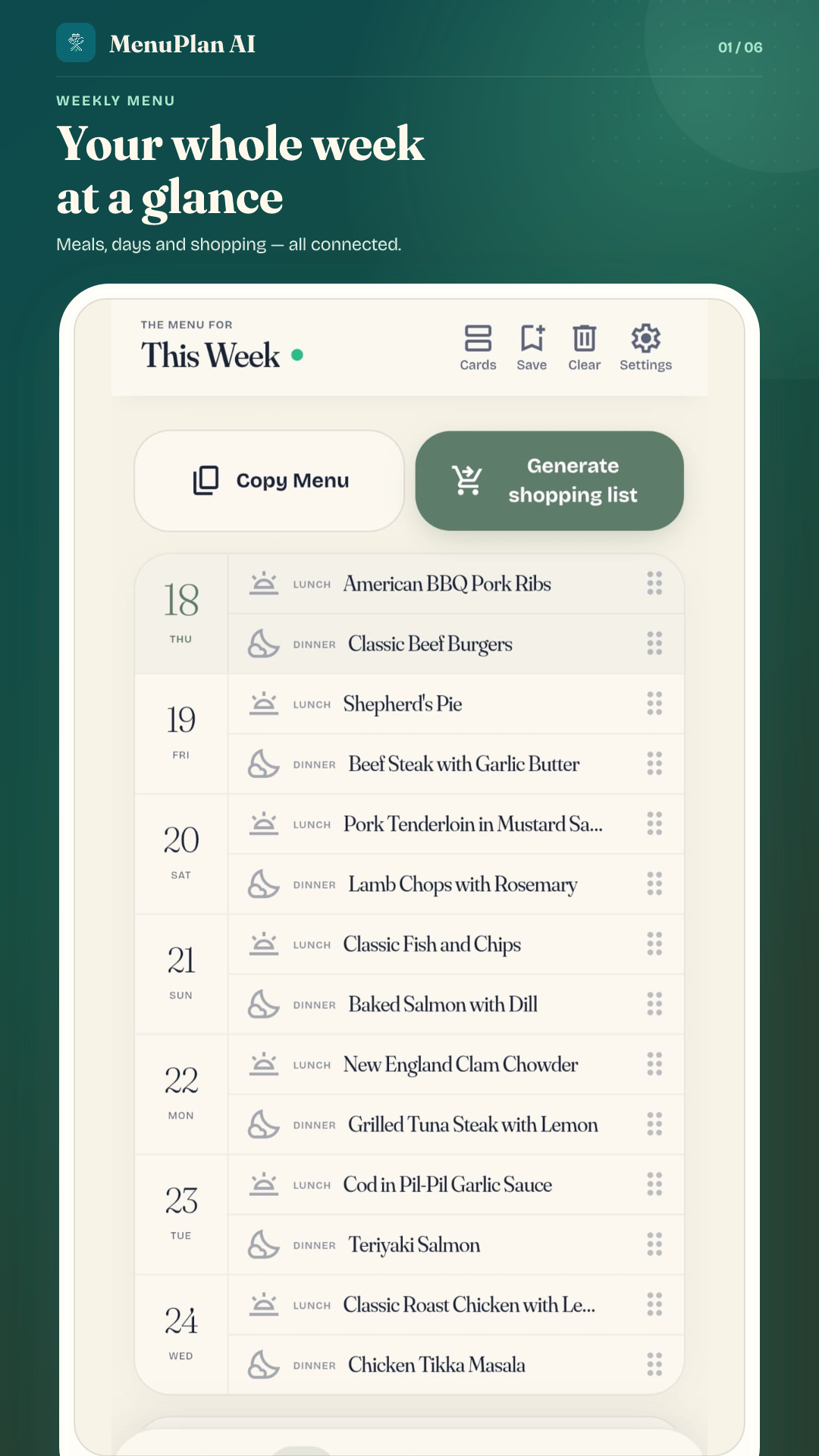
I'm Manuel, the creator of MenuPlan AI. I built it around a household routine: keep the recipes you actually cook, decide the week's lunches and dinners, then prepare the shopping list from that plan.The Android app is live on Google Play and currently free, without advertising or subscriptions. It supports English, Spanish, French, German, Italian and Portuguese. This is a sale of an early-stage product and agreed assets, with a small recorded user base and no revenue to date.What a user can do today1. Build and maintain a recipe collection. Add recipes and ingredients, search and filter the collection, and keep preparation instructions with a recipe. Import a recipe from a compatible website, or use AI-assisted import from a photo of a written recipe or pasted text, or generate a draft recipe from a dish name. Users review the result before saving. Recipe exports include readable TXT/PDF files and a JSON backup that can be restored; TXT and PDF are not restore formats.2. Plan lunches and dinners with specific rules. Select dates, keep fixed dishes, mark days or meals to skip, choose quick/normal/elaborate recipe preferences, and set weekly category targets. Build a menu from the saved recipes, change individual dishes and reuse saved planning patterns. The automatic planner is a local rule-based algorithm: it does not ask an LLM to invent the week's menu.3. Shop from the plan. Generate the shopping list when ready: ingredient quantities scale with servings and compatible units are combined. Organize it by aisle, add or edit items and check off purchases. If the menu changes, the app prompts the user to update the list; it is not continuously regenerated in the background. Household members can share menus, recipes and shopping lists. The pantry feature can exclude selected staples from shopping; it is not a stock system that tracks quantities or expiry dates.4. Review and reuse the household's data. View menu history, recipe frequency and weekly summaries. Nutrition displays are approximate and depend on the available ingredient data; missing data is not complete nutrition coverage. Guest mode allows local exploration on one device without an account; its statistics tab is hidden. Already-loaded recipes, plans and lists can be used offline. Shared household sync requires an account and connectivity.The accompanying website explains the product and includes editable weekly planners in English and Spanish. Those planners save in the browser and are separate from the Android app; there is no web-to-app synchronization claim.What the AI actually doesThe user-facing AI tools cover import from written-recipe photos and text, generation of draft recipes from dish names, drafting preparation steps from a recipe's ingredients, and suggesting grocery aisles for individual items or a batch. AI needs sign-in, a verified email and an internet connection; it is not part of guest mode. Outputs can need correction.The current repository routes photos to Anthropic Claude Haiku 4.5. Text tasks use Cloudflare Workers AI with Llama 3.1 8B Instruct Fast and a Claude fallback for technical failures. Authentication, caching and per-user daily quota code are present. These are the configured implementation details, not a promise of unlimited usage or a verified monthly operating cost.Compatible website imports parse structured recipe data such as JSON-LD or microdata. They do not use AI. The weekly planning algorithm and local browsing also do not require an AI request. This separation gives a buyer a concrete starting point for controlling inference costs while keeping the core routine usable without them.Product and technical assetsThe application uses React, TypeScript, Vite and Capacitor for Android. Firebase handles identity and shared data. A Cloudflare Worker, KV and Workers AI support backend operations, with Anthropic for selected AI requests and Resend for contact email. The marketing site uses React with Vinext/Next.js-compatible routing, Vite and Sites deployment.The proposed package includes the app source and Android build project, backend code and configuration, marketing-site source, screenshot-generation tooling, documentation and store/brand materials whose ownership and transfer rights are confirmed during diligence. There are six real UI screen types and 60 prepared images across ten regional store-asset sets; this means six app languages, not ten different interfaces.Release preparation for Android 1.2.5 (27) records 568 passing app tests and signed artifacts. The latest recorded Play state is review; the new version is not claimed publicly available here. Those checks are evidence of the tested scope, not a guarantee that every device or cloud-service flow is defect-free.Traction and current financesRecorded Play Console figures are 21 cumulative acquisitions as of 25 September 2026, 15 users with the app installed as of 26 September, and 4 active users in the 28-day window ending 24 September. These are different metrics with different dates, not a conversion funnel, paying customers or verified organic-only users. Owner/tester usage has not been separated from external users.On 2 October 2026, the owner confirmed USD 0 revenue and USD 0 donations to date. These are owner-reported figures, not independently audited accounts. The optional donation link has produced no donations. There are no existing subscription customers, paid tiers or implemented Play Billing purchase flows. Attributable hosting, AI and other operating expenses still need to be documented; zero revenue does not mean zero cost or zero loss.Monetization paths a buyer could testThese are potential development directions, not implemented paid products or a revenue forecast:AI credit packs: sell a defined allowance of imports or other AI requests. Metering can connect price to usage, but purchase validation, entitlements, refunds and margins need implementation and testing. Existing daily quota code is not a payment system.Freemium: keep the present core routine free and test additional premium convenience or reporting features. A useful upgrade and willingness to pay still need to be established; current planning and exports should not be presented as paid features.Household subscription: build extra household administration or shared workflows beyond today's free synchronization. A recurring plan would need ongoing value and support, with a bounded AI allowance if AI is included.One-time in-app upgrade: sell future local enhancements or properly licensed content packs. A one-off payment is a poor match for unlimited ongoing AI and cloud costs, so those costs would need separate limits or pricing. This means a future in-app unlock, not converting the already-free app download into a paid app.The current quota store is not a transactional credit balance. A paid launch would need a purchase and entitlement implementation, with backend validation and the applicable Google Play billing flow. Google distinguishes consumable and non-consumable products and documents secure purchase processing.Handover and boundariesThe exact transfer scope, support period and asset rights would be agreed with the buyer. Play app transfer, Firebase access/billing and backend deployment need a coordinated plan. The installed app currently references a Worker URL associated with the present account, so continuity of that endpoint or an app update must be planned; handing over source alone does not migrate running users. The website deployment/URL also needs an agreed destination.Third-party code and fonts retain their licenses. Recipe-catalog, image, icon and contribution provenance must be confirmed before promising exclusive rights. Personal accounts, unrelated projects, balances, private credentials and social profiles are not included by default. Handover should use aggregate evidence and a defined operational transition, not a public export of users' personal data.I can discuss the product workflow and the concrete assets with a buyer. There is no promise of future revenue, traffic, sale value or permanently free hosting.Asking priceUSD 2,900, negotiable. Early-stage product and agreed assets; final price, rights, transfer scope and support to be agreed with the buyer.
Comments (0)
No comments yet. Be the first to comment!
Related Products

Lynxify.me
360-degree feedback software for small teams

Free Knitting Calculators: Gauge, Decrease & Yarn Tools (AI-Enhanced) | StitchMa
ThinkSpatial
Bookmark AI
Browser extension and dashboard to auto-tag and AI-search saved YouTube videos
IdeaGrit
pressure-tests your idea and helps you commit to the right hard thing.

RentalReady — Turnover Tracker
Turnover checklist and inspection tracker for short-term rental hosts.