 ComingUp
PROJECT ATLAS
Cargo contact-force, load redistribution and deformation analysis software.
Is this your project? Ask us to take it down
Gallery
About
PROJECT ATLAS — Cargo Load Engineering, Physical Contact Modeling and Planning Technology
PROJECT ATLAS is a developed Windows-based cargo engineering and logistics planning software asset offered for strategic acquisition, source-code transfer, or a negotiated technology licensing arrangement.
The software goes beyond conventional cargo placement and dimensional loading checks. It combines geometry and handling constraints, load-bearing contact calculations, support-force redistribution, material deformation, time-dependent physical response, and controlled loading-plan modification within a connected software environment.
The primary value of PROJECT ATLAS lies in its existing numerical implementations, planning workflows, source-code assets, SDK interfaces, and documented local verification evidence. The technology may be relevant to logistics software vendors, warehouse and transportation management providers, packaging engineering businesses, and companies evaluating specialized load-planning or physical-response capabilities.
The current development phase has been concluded, and the existing technical assets have been preserved for acquisition evaluation.
Technical capabilities
1. Cargo geometry, structural support and handling-path evaluation
PROJECT ATLAS evaluates supported three-dimensional cargo geometry, including defined non-convex shapes, containment, geometric intersections, collision constraints, support relationships, inclined bearing configurations, and cargo handling paths.
The software distinguishes between a cargo arrangement that is geometrically valid at its final position and one that can be reached through a feasible handling movement.
Supported handling evaluations include declared translation, rotation, equipment geometry, placement and release sequences, and intermediate collision conditions.
These capabilities provide a foundation for evaluating cargo configurations against more than basic dimensional fit.
2. Contact forces, support reactions and load distribution
The software includes numerical evaluation of load-bearing contact relationships between supported cargo and structural or packaging surfaces.
Implemented capabilities include normal and tangential contact-force components, support reactions, pressure-related constraints, declared force and moment limits, and load redistribution under changing support conditions.
For example, when an item rests on multiple support points, the advanced implementation can evaluate how declared support reactions change when the supporting geometry or contact state changes.
The model can distinguish between active load-bearing contact, contact opening with zero transmitted reaction, and subsequent recontact within its supported assumptions.
This enables the technical examination of which contacts carry a load, how the support forces are distributed, and whether a calculated condition exceeds applicable declared limits.
3. Material deformation, compression and recovery
PROJECT ATLAS includes bounded numerical material-response models for supported packaging and cushioning conditions.
The implementation addresses load-dependent deformation, normal-force response, time-dependent material behavior, unloading and recovery, reloading, residual deformation, and accumulated energy dissipation where supported by the selected model.
Material response can be evaluated using declared loading histories and model parameters rather than treating all packaging materials as perfectly rigid.
The advanced implementation also connects supplied changing support surfaces to contact evaluation and the redistribution of supporting reactions.
These capabilities are intended for numerical engineering evaluation. Their application to actual products requires appropriate material parameters and independent physical validation.
4. Spatial dynamics, friction and contact transitions
PROJECT ATLAS contains defined six-degree-of-freedom rigid-body and contact-response calculations.
The supported numerical workflows include translational and rotational motion, applicable frictional behavior, compliant contact response, cushioning and restraint conditions, lift-off, contact separation, recontact, and force, moment and energy-related evaluations.
The advanced coupled model addresses changing support surfaces and contact-state transitions while preserving relevant material and contact-history information within its declared scope.
Time-dependent loading, vibration and shock-related workloads are supported under specified numerical assumptions and input conditions.
The software is not marketed as a universally validated structural failure predictor or a certified cargo safety assessment system.
5. Cargo planning, protected modifications and decision recovery
PROJECT ATLAS also includes a complete planning workflow designed to preserve the integrity of existing cargo arrangements when modifications are evaluated.
A user or calling application can examine a proposed change before committing it.
The software provides protected replanning, preview, explicit application of calculated results, cancellation, Undo/Redo, and persistent workspace recovery.
The original executable has been tested for actual calculation cancellation without unintentionally applying discarded results.
This workflow is relevant to operational environments where shipment requirements, available cargo, loading instructions or execution conditions change after an initial plan has been prepared.
Rather than replacing a previously accepted plan automatically, the application maintains a distinction between a proposed modification and an explicitly accepted result.
6. Packaging, loading compartments and operational constraints
The broader software includes functionality covering supported packaging and layered cargo structures, compartment and exposure constraints, special cargo rules, fleet and route-related planning, and execution-history workflows.
These functions share data contracts with the planning, geometry, persistence and reporting systems.
Their applicability depends on the declared input models and the relevant configuration. Not every physical cargo type, manufacturing format or equipment arrangement is automatically supported.
7. Software integration, data persistence and reporting
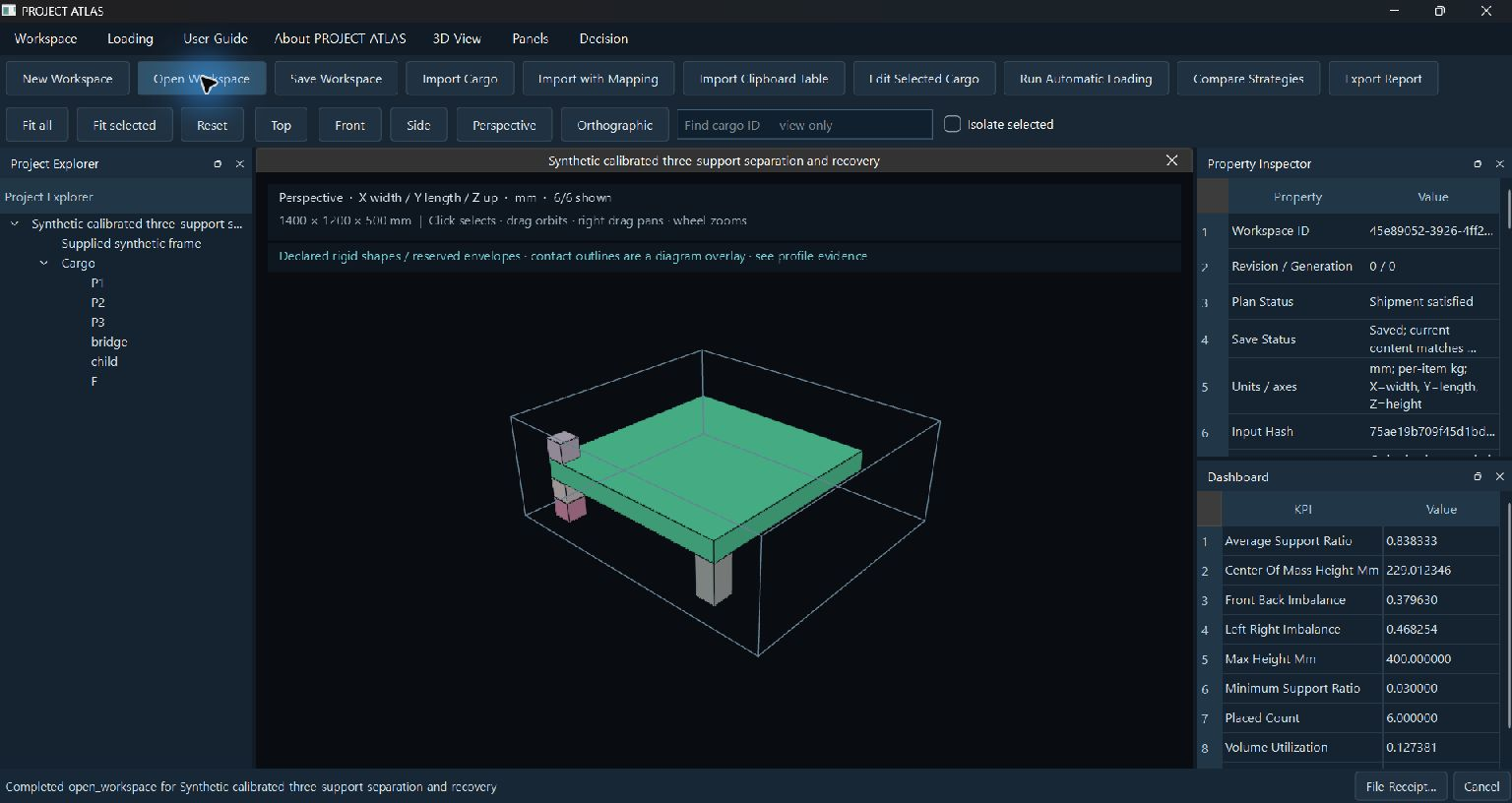
PROJECT ATLAS includes a Windows desktop reference application, programmatic SDK/API operations, persistent planning documents, and linked JSON/PDF reporting.
Implemented workflows include saving and reopening workspaces, maintaining planning state, processing calculations through defined programmatic interfaces, and generating corresponding reports.
The current technical assets provide a basis for evaluating how selected calculation or planning workflows could be incorporated into an existing logistics software platform.
Direct compatibility with any specific third-party WMS, TMS, ERP or cloud platform has not been established and would require a separate integration assessment.
Potential commercial applications
PROJECT ATLAS may be relevant to organizations developing or extending cargo loading, warehouse management, transportation planning, packaging engineering and specialized logistics applications.
Potential evaluation scenarios include:
Additional contact-force or support-pressure assessment for selected loading arrangements.
Comparison of support reactions and deformation states before and after an authorized cargo arrangement change.
Numerical evaluation of declared cushioning or material-response conditions for suitable packaging configurations.
Analysis of changing contact states, support loss and recontact under defined loading conditions.
Controlled replanning workflows in which proposed changes must be reviewed, accepted, rejected, reversed or reproduced.
Integration of selected engineering calculations into an existing enterprise planning system, subject to technical compatibility and licensing requirements.
These applications are proposed areas for buyer evaluation, not claims of completed customer deployment or verified operational cost savings.
Development and verification status
PROJECT ATLAS is implemented software with existing source code, executable builds and recorded local verification evidence. It is not an undeveloped concept or a design-only project.
The R6BO-local1 baseline has completed documented local acceptance procedures covering the original and independently restored application, SDK functionality, rollback, installation and data preservation, together with a verified installation and source review package.
The more advanced R6BP R5 version contains the coupled changing-support and contact-response implementation and has been frozen for potential acquisition evaluation.
Its recorded verification includes an 858-file source tree, 2,650 unique passing source tests, 158 passing Windows tests, 91 original-executable SDK checks, five defined original-executable performance cases measured twice, and actual GUI/document workflow checks.
Independent restoration and rollback have also been completed for 1,008 runtime files and 54 data files.
The local tests cover defined synthetic numerical cases, software behavior, workflow consistency and relevant compatibility conditions.
Final R6BP R5 acceptance is not complete. Remaining work includes selected restored-environment performance cases, restored SDK and GUI/document checks, installation/data-preservation acceptance, and final release-package verification.
The software is not represented as independently validated on customer production infrastructure or as outperforming existing commercial products.
Physical and technical limitations
The physical-response models operate within stated assumptions, supported geometries, supplied material parameters and applicable numerical conditions.
Actual engineering applications require verified dimensions, mass and center-of-mass data, contact geometry, stiffness, friction, compliance, damping, restraint information and relevant loading histories.
Independent experimental validation would be necessary before relying on the calculations for real cargo damage prevention, physical safety certification or unrestricted operational use.
The existing records distinguish software numerical verification from material calibration, physical experiments and customer-specific deployment acceptance.
Transaction opportunity
The preferred transaction is the acquisition of the complete PROJECT ATLAS software and agreed first-party source-code technology assets, including applicable technical documentation, SDK interfaces and relevant verification materials.
A defined functional-source acquisition or licensing arrangement may also be considered where a buyer is interested in a particular technology area, such as contact mechanics, material-response calculations, controlled replanning or software integration workflows.
Individual functional groups share dependencies and have not been separately extracted and qualified as standalone products. Any selective transfer would require an agreed scope, dependency assessment and acceptance conditions.
Transferable ownership, contributor rights and applicable third-party software licenses must be confirmed during transaction due diligence. Third-party libraries are not represented as exclusively owned intellectual property.
PROJECT ATLAS is offered as an existing technical software asset rather than a revenue-generating SaaS business. The asking price and transaction structure are subject to negotiation according to the agreed asset scope and buyer requirements.
Non-confidential technical summaries, capability descriptions and version-specific verification information are available for preliminary review. Detailed source-code access or confidential implementation materials would require an appropriate confidentiality process and confirmation of disclosure rights.
Interested buyers, software vendors, technology acquisition teams and engineering organizations are welcome to contact the owner to discuss technical fit, potential source-code acquisition, licensing or structured due diligence.
Comments (0)
No comments yet. Be the first to comment!
Related Products
iZoneMedia360 .com – Trusted Hub for Startup & Tech Innovation Trends
An SEO-ready content blog focused on digital media, tech, and business topics wi
Kanso Rental Property Management System
High-end rental property management tool with little competition + large market
Aakhya.AI - Intelligent Cloud Cost Optimization Platform
Intelligent Cloud Cost Optimization Platform

Workalizer
Google Workspace AI-driven insights to improve productivity and performance

e-mail.dev
Turnkey email validator Micro-SaaS on a premium .dev domain.
The Real World of Autism
Globally raising Autism Awareness and Monetizing all parties