 ComingUp
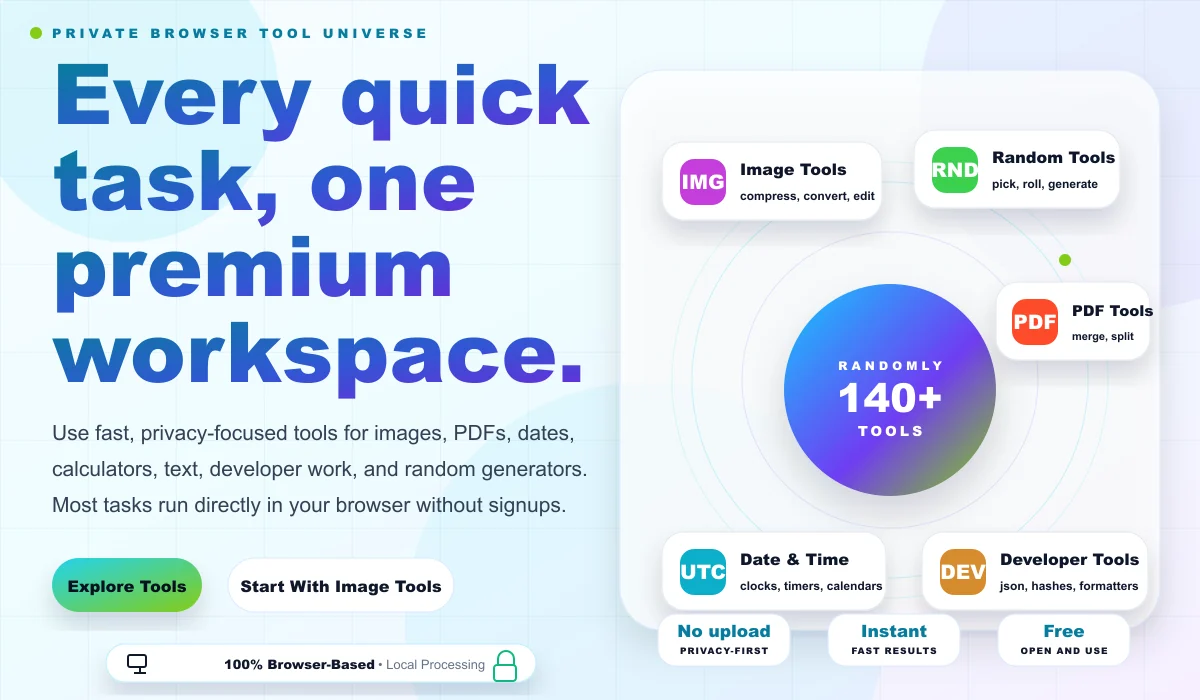
Randomly.online - A tool ecosystem
Building Randomly.online, a privacy-first platform with 400+ fast browser-based

Gallery
About
Building Randomly.online: A Privacy-First Platform of 400+ Web ToolsI started Randomly.online with a simple idea:What if everyday online tools could do most of their work directly in the user's browser instead of sending their data to a server?Today, Randomly is evolving into a large collection of 400+ browser-based utilities covering areas such as text, calculators, converters, developer tools, SEO, data, images, productivity, PDFs, and more.The goal isn't simply to create a website with hundreds of tools. The long-term goal is to build a privacy-first utility workspace where users can solve everyday problems quickly without unnecessary accounts, uploads, or data collection.Why I Built ItMany utility websites follow a simple pattern:Upload → Server processes the file → Download resultThat works, but for many tasks it isn't necessary.If someone wants to:format JSONcalculate a percentageconvert unitsmanipulate textgenerate a colorresize an imageprocess certain documentsdecode/encode datathe user's own device can often perform the operation.So I decided to make client-side processing one of the central principles of Randomly.The idea is simple:Don't send user data to a server when the browser can do the job itself.The TechnologyRandomly is built primarily using:HTML + CSS + TypeScriptrather than relying on a large frontend framework for every tool.This approach works particularly well for a platform where many utilities are relatively independent.The architecture allows individual tools to remain lightweight while sharing common components, styles, utilities, validation logic, and UI patterns.The platform is designed around:Client-side computation where practicalResponsive designFast loadingMinimal dependenciesReusable tool componentsIndependent tool URLsSEO-friendly pagesLocal browser storage where appropriate400+ Tools, But Not Just 400 PagesOne of the challenges of building a large utility platform is avoiding the creation of hundreds of nearly identical pages.The objective is not:"How many tools can I create?"Instead, the question is:"What useful problem does this tool solve?"For example, the developer category can contain tools for:JSON formattingJSON validationBase64 encoding/decodingURL encodingRegex testingUUID generationtimestamp conversionHTTP utilitiesdata conversionCSS generationMarkdown processingand many others.Similar tool clusters exist for mathematics, text, images, SEO, business, education, productivity and everyday utilities.Privacy by ArchitecturePrivacy isn't something I want Randomly to communicate only through a privacy policy.I want the architecture itself to reflect that principle.When a tool can run completely inside the browser, there is no reason to upload the user's content simply to process it.That can be particularly important when users are working with:documentstextcodeimagesbusiness datapersonal informationOf course, not every possible feature can be completely client-side. Some functionality—especially services requiring live external information—can require network requests.For that reason, one of my goals is to make the distinction clear:Client-side tools Processing happens locally whenever practical.Online tools Network access is required and should be clearly identified.The Challenge of Building Hundreds of ToolsThe hardest part isn't creating the first few tools.It's maintaining consistency as the platform grows.When you have hundreds of utilities, small problems multiply:Different UI patternsDifferent validation behaviorInconsistent error messagesDifferent mobile experiencesDuplicate codePerformance regressionsAccessibility issuesSEO problemsTesting complexityThis pushed me toward creating reusable foundations instead of treating every tool as a completely independent project.The goal is to make adding the next tool increasingly easier without sacrificing quality.SEO for a Large Utility PlatformEach useful tool can potentially answer a different search intent.Instead of putting everything behind one generic tools page, Randomly uses dedicated URLs for individual utilities.For example:/tools/json-formatter/tools/percentage-calculator/tools/color-converterand so on.This creates a structure where users can discover the exact utility they need directly from search engines.I'm also building a /blogs section where articles can explain common problems, workflows, and concepts related to the tools.The idea is to connect:Search → Article → Tool → Related toolsrather than creating content purely for search-engine rankings.From Website to PlatformRandomly started as a website, but I'm increasingly thinking about it as a platform.The roadmap includes:WebA large collection of fast, privacy-focused utilities.AndroidA lightweight mobile application where users can choose which tools they actually want available on their device.Offline toolsTools that can remain usable without an internet connection.WorkspaceA local-first environment where users can keep their work and frequently used tools together.AutomationEventually, compatible tools could be chained together.For example:CSV → Clean → Remove duplicates → Sort → Exportor:Images → Resize → Compress → Convert → ZIPThis would turn individual utilities into reusable workflows.What I'm LearningBuilding Randomly has taught me that a large product is often less about the individual features and more about the systems underneath them.A single tool may take hours or days to build.But creating an architecture that makes the 100th tool easier than the 10th is much more valuable.I've also learned that building in public and measuring actual user behavior is more useful than assuming what users want.Instead of deciding everything upfront, I want usage patterns to influence what Randomly becomes next.What's NextThe long-term vision is not simply to reach a larger number of tools.I want Randomly to become a privacy-first digital utility workspace.That means moving from:individual toolsto:tool collectionsto:workflowsto:a unified workspacewhile keeping the experience lightweight and accessible.The goal is to make Randomly useful for developers, students, professionals, creators, and everyday users without requiring them to install dozens of separate utilities.Final ThoughtThe internet doesn't always need another complicated application.Sometimes people just need a small tool that works immediately.That's what I'm trying to build with Randomly:A large collection of useful tools that are fast, simple, privacy-conscious, and increasingly capable of working together.The journey is still early, and there is a lot left to build. 🚀
Comments (1)
400 tools in the browser, nice. how do you handle pricing for all that?
Related Products

Lynxify.me
360-degree feedback software for small teams

Free Knitting Calculators: Gauge, Decrease & Yarn Tools (AI-Enhanced) | StitchMa

ThinkSpatial
Bookmark AI
Browser extension and dashboard to auto-tag and AI-search saved YouTube videos

IdeaGrit
pressure-tests your idea and helps you commit to the right hard thing.

RentalReady — Turnover Tracker
Turnover checklist and inspection tracker for short-term rental hosts.